


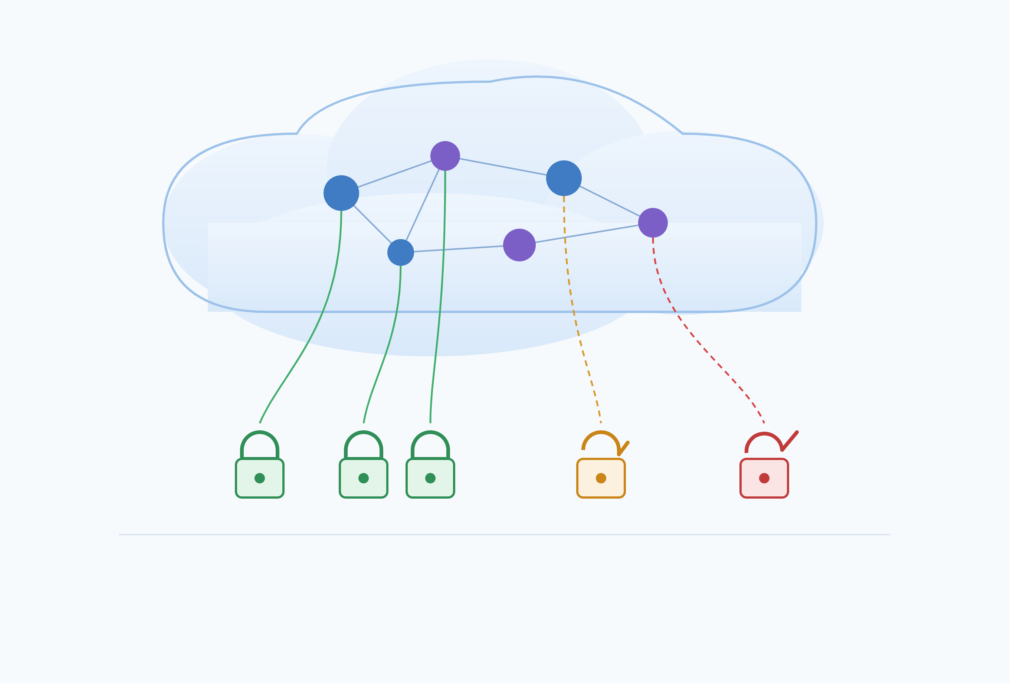
CIEM and cloud access risk
Cloud breaches rarely start with a zero-day. They begin with an identity that had more access than needed. This includes a service account nobody remembered, a temporary role, and a stale credential. A temporarily granted role during an incident eighteen months ago still poses risk.
As cloud environments grow more dynamic, this quiet accumulation of access rights becomes increasingly risky. Excess permissions remain the dominant source of cloud risk across many organizations. CIEM, or Cloud Infrastructure Entitlement Management, provides tools to identify and remediate those excess privileges. By continuously assessing identities, CIEM helps prevent breaches caused by over-privileged access.
This guide covers what a CIEM platform should do, why the problem it solves has become urgent, ten credible CIEM solutions to know in 2026, and how to choose the right one for your organization.
What Should a CIEM Platform Do?
A capable CIEM platform needs to do more than list who has access to what. At minimum, it should:
- Discover every identity across your clouds — human users, service accounts, roles, and increasingly, non-human and AI-agent identities — across AWS, Azure, GCP, and any other platforms in use.
- Map granted versus effective permissions. The permissions written into a policy document and the permissions an identity can actually exercise are often very different once inherited roles, group memberships, and resource policies are accounted for. A CIEM tool needs to resolve that gap accurately.
- Surface unused and excessive access. By comparing granted permissions against actual activity, the platform should identify standing access that is doing nothing but sitting there as risk.
- Prioritize by real exposure, not raw permission counts. Thousands of over-privileged findings are not useful on their own. The best platforms rank findings by what’s actually reachable — toxic combinations of identity, exposure, and sensitive data — so teams fix what matters first.
- Support least-privilege remediation. This can mean auto-generated right-sized policies, guardrails, or full just-in-time (JIT) access with zero standing privilege, where permissions are granted only for the duration they’re needed.
- Cover non-human identities. Machine identities now outnumber human ones by a wide margin in most cloud estates, and they’re frequently the most over-privileged and least monitored.
- Integrate with the rest of the security stack, including CSPM, vulnerability data, and SIEM/SOAR, so entitlement risk is understood in the context of broader exposure rather than in isolation.
What Is CIEM (Cloud Infrastructure Entitlement Management)?
CIEM is a software category — the term was coined by Gartner — that manages and secures access to cloud resources by monitoring and controlling the privileges and permissions of both human and machine identities across cloud platforms. Traditional identity and access management (IAM) tools were built for relatively static, on-premises environments. Cloud IAM is a different problem: permissions are granted through overlapping mechanisms (cloud-native IAM policies, roles, resource policies, group memberships), identities are created and destroyed constantly by automation, and a single cloud account can easily have far more distinct permissions than any team can track manually.
CIEM tools address this by continuously discovering identities and calculating their effective permissions. They flag where access exceeds what is needed, and help security and platform teams shrink it. This approach aligns security with cloud operations and reflects evolving cloud-native protections.
Ideally, this process occurs without breaking anything in production. In practice, CIEM has become a pillar of CNAPP, alongside CSPM and CWPP, not a standalone category. As a result, teams can manage access risks while maintaining agility. The CNAPP framework positions CIEM beside CSPM and CWPP for comprehensive protection.
Why CIEM Tools Matter: Entitlement Sprawl & Identity Risk
Perimeter-based security assumptions don’t hold up well in the cloud, where the real attack surface is increasingly identity and entitlement misuse rather than a network boundary. A few dynamics make this an urgent problem rather than a nice-to-have:
- Cloud environments move faster than manual review can track. Infrastructure auto-scales, workloads spin up and disappear, and permissions proliferate right along with them.
- Temporary access rarely gets revisited. Permissions granted during an outage or incident response often quietly become permanent, turning a short-term shortcut into a long-standing backdoor.
- Non-human identities are exploding in number. Service accounts, CI/CD pipelines, and now AI agents routinely accumulate broad permissions that no one is actively monitoring, and they can’t be governed the same way as human users with periodic access reviews.
- Multi-cloud complexity compounds the problem. Every provider has its own permission model, and few organizations have a unified view of entitlements across AWS, Azure, and GCP simultaneously.
- The numbers back it up. Industry surveys consistently show that a large majority of enterprises are concerned about public cloud security, and a substantial share of cloud hosting providers have reported breaches tied to excessive or mismanaged access.
The result: access risk, not infrastructure misconfiguration alone, has become a leading cause of cloud breaches. Without continuous, automated insight into who can access what and why, even well-resourced security teams are effectively operating blind.
Top 10 CIEM Solutions in 2026
There’s no single best CIEM tool for every organization — a Microsoft-centric enterprise, a complex multi-cloud estate, and a developer-driven startup all have different requirements. Below are ten credible options worth putting on a shortlist, drawn from current market analysis and vendor comparisons.
1. Wiz — An agentless CNAPP with CIEM built on its Security Graph, which correlates identities, misconfigurations, vulnerabilities, and network exposure into attack paths. It normalizes explicit versus effective permissions across AWS, Azure, GCP, and OCI, plus Kubernetes and major SaaS platforms, and includes a dedicated non-human-identity dashboard. Best for organizations that want entitlement risk understood in the context of the broader cloud attack surface. The trade-off: CIEM isn’t sold standalone, and the value depends on adopting the wider Wiz platform.
2. Orca Security — Another agentless-first CNAPP, differentiated by contextual risk prioritization that cuts through large volumes of over-privilege findings to surface what’s actually reachable and dangerous. Native multi-cloud coverage spans AWS, Azure, and GCP. A strong fit for teams that are drowning in raw entitlement alerts and need help triaging.
3. Tenable Cloud Security — Built on the identity-first foundation of Ermetic, which Tenable acquired in 2023, this is one of the stronger pure-play CIEM lineages on the market. It offers deep effective-permission analysis, automated least-privilege recommendations, and just-in-time access, now folded into Tenable’s broader exposure-management portfolio. Best for organizations that want identity-first cloud security and already use Tenable elsewhere.
4. CrowdStrike Falcon Cloud Security — Brings adversary-aware, threat-informed risk scoring to cloud entitlements, tying identity risk to real-time threat detection rather than treating it as a static posture problem. A good fit for organizations that want entitlement analysis integrated with active threat detection.
5. Microsoft Entra Permissions Management — Provides multi-cloud entitlement visibility and right-sizing across AWS, Azure, and GCP with native Entra integration. The natural choice for Microsoft-centric enterprises extending existing identity governance into cloud entitlements, though its strongest fit is within organizations already standardized on the Microsoft ecosystem.
6. SailPoint Identity Security Cloud — Extends SailPoint’s identity governance (IGA) heritage into cloud entitlements, applying formal governance and certification workflows to cloud access. Well suited to organizations that already run identity as an audited, compliance-driven program and want cloud entitlements folded into that same governance model.
7. CyberArk Secure Cloud Access — Approaches cloud entitlements from CyberArk’s privileged access management (PAM) roots, focusing on zero standing privilege and just-in-time elevation for cloud identities. Best for organizations already running CyberArk PAM that want to extend the same discipline to cloud access; it’s stronger on privileged access and session control than on broad cloud posture.
8. Sonrai Security — An identity-graph specialist built around deep effective-permission and data-access analysis. Sonrai traces chained identity-to-data relationships across clouds, which is valuable for spotting complex access paths that simpler entitlement inventories miss. Best for organizations that need graph-based visibility into exactly which identities can reach which sensitive data.
9. Britive — A purpose-built, cloud-native CIEM and cloud-PAM platform centered on just-in-time access and zero standing privileges, with an agentless, API-first architecture across AWS, Azure, GCP, and OCI. Arguably the most focused dedicated-CIEM story on this list, for organizations that specifically want active enforcement rather than visibility alone.
10. Palo Alto Networks (Prisma Cloud / Cortex Cloud) — Offers CIEM as part of a broader CNAPP, analyzing effective permissions and tying entitlement findings to wider posture and workload data. A strong fit for organizations standardizing cloud security from code to runtime under one platform, though CIEM here is a module within a larger suite rather than a standalone focus.
(Other vendors worth knowing in this space include Saviynt, BeyondTrust, Zscaler, and Check Point, each of which offers CIEM capabilities as part of broader identity or cloud security platforms.)
How to Choose the Best CIEM Solution
There’s no universal winner — the right choice depends on your cloud footprint, your team’s maturity, and what you’re optimizing for. A few criteria to weigh:
- Coverage of your actual cloud estate. Confirm the platform supports every cloud provider you run, not just the major three — and check coverage of Kubernetes, SaaS platforms, and any less common environments in your stack.
- Effective-permission accuracy. The core value of CIEM is resolving what an identity can actually do, not just what a policy document says. Test this claim directly during a proof of concept against your real environment rather than taking it on faith.
- Standalone CIEM vs. CIEM inside a CNAPP. Decide whether you want a dedicated entitlement platform or are comfortable getting CIEM as one module of a broader cloud security suite. Standalone tools tend to go deeper on identity; CNAPP-embedded CIEM gives you correlation with posture and workload risk in one console.
- Non-human identity support. Given how heavily machine identities now outnumber human ones, confirm the platform treats service accounts, CI/CD credentials, and AI agents as first-class citizens, not an afterthought.
- Prioritization, not just detection. A tool that produces thousands of undifferentiated over-privilege findings creates alert fatigue rather than solving the problem. Look for genuine risk-based ranking.
- Enforcement model. Decide how active you want remediation to be — auto-generated policy recommendations, guardrails, or full just-in-time access with zero standing privilege. The more automated the enforcement, the more carefully you’ll want to test it against production workflows before rollout.
- Fit with existing governance. If your organization already runs formal identity governance and certification (IGA), a platform that extends that model may integrate more naturally than a bolt-on tool.
- Ease of use and vendor support. Look for intuitive interfaces, understandable reporting, and a vendor support model — training, technical support, ongoing updates — that matches your team’s capacity to operate the tool day to day.
- Scalability and pricing model. Most CIEM vendors price on custom quotes tied to cloud resource count or identity volume rather than public list pricing, so validate cost scaling against your growth projections, not just your current footprint.
A practical next step: narrow to a two-vendor shortlist based on the criteria above.
Moreover, run a scoped proof of concept against your AWS, Azure, and GCP environment to validate effective-permissions accuracy before committing.
Conclusion
CIEM has moved from a niche audit tool to core cloud security infrastructure.
As cloud environments scale automatically and non-human identities multiply, entitlement sprawl remains a major, preventable driver of breaches. Traditional IAM and perimeter tools were never built to address it.
The strongest teams treat it not as a compliance checkbox but as a continuous discipline. They inventory every identity, understand permissions, cut standing access, and enforce least privilege without hurting production.
There’s no single best CIEM platform for every organization. What matters most is choosing a tool that fits how your teams actually operate — deep graph-based visibility for complex multi-cloud estates, native integration for Microsoft-centric environments, or low-friction, risk-prioritized findings for developer-driven teams — and validating its claims against your own environment before you commit.


