Scientific phenomena are observable events — like lightning, rainbows, or static electricity — that follow predictable natural laws. Scientists explain them by identifying cause-and-effect relationships, often rooted in physics, chemistry, or biology. Understanding these patterns turns everyday confusion into clear, testable knowledge.
You see unexplained science every day. A rainbow appears after rain. Your phone charges without a cord. Static shocks you when you touch a doorknob. These moments spark curiosity, but most people never learn the “why” behind them.
This guide breaks down seven common scientific phenomena explained in plain terms. Each section defines the concept, shows a real-world example, and gives you one fact you can use or share immediately — whether you’re a curious beginner or a small business owner looking to write informed content for your audience.
Why is the sky blue?
The sky is blue because of Rayleigh scattering — a process where shorter wavelengths of light scatter more than longer ones. Sunlight contains all visible colors, but blue light has a shorter wavelength than red or yellow. When sunlight hits Earth’s atmosphere, air molecules scatter blue light in all directions far more than other colors. That scattered blue light is what reaches your eyes from every direction in the sky, according to NASA’s Earth Observatory.
At sunrise and sunset, sunlight travels through more atmosphere, scattering away most blue light and leaving the reds and oranges you see.
How does a magnet work?
A magnet works by aligning the electrons inside certain materials so their magnetic fields point in the same direction. Every electron generates a tiny magnetic field. In most materials, these fields cancel each other out. In magnetic materials like iron, nickel, and cobalt, the fields line up, creating a combined force strong enough to attract or repel other magnetic objects.
This same principle powers electric motors, MRI machines, and the speakers in your phone.
What causes static electricity?
Static electricity builds up when two surfaces rub together and transfer electrons from one to the other. One surface ends up with extra electrons (a negative charge), while the other loses electrons (a positive charge). When that imbalance finds a path to discharge — like your finger touching a doorknob — you feel the shock.
Dry air makes static shocks more common because moisture normally helps dissipate the charge before it builds up.
Why does ice float on water?
Ice floats because it’s less dense than liquid water. When water freezes, its molecules form a crystalline structure with more space between them than in liquid form. That extra space makes ice about 9% less dense, so it floats instead of sinking.
This property keeps lakes and oceans from freezing solid from the bottom up, allowing aquatic life to survive beneath winter ice.
What makes a rainbow appear?
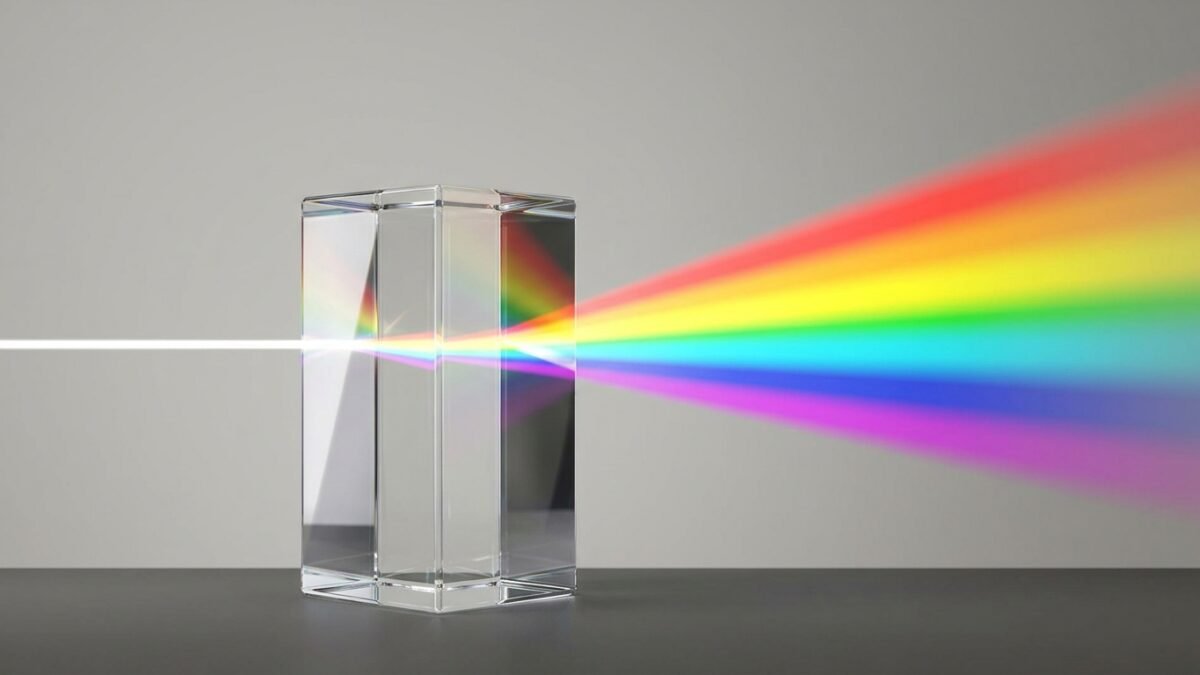
A rainbow appears when sunlight passes through water droplets and splits into its component colors through refraction and reflection. Light bends as it enters each droplet, reflects off the droplet’s inner surface, then bends again as it exits — separating white light into the visible spectrum of red, orange, yellow, green, blue, indigo, and violet.
You’ll only see a rainbow when the sun is behind you and rain is in front of you, at roughly a 42-degree angle.
Why do leaves change color in autumn?
Leaves change color because shorter days and cooler temperatures stop chlorophyll production, revealing pigments that were present all along. Chlorophyll gives leaves their green color and masks other pigments like carotenoids (yellow and orange) and anthocyanins (red and purple). As chlorophyll breaks down in fall, these underlying colors become visible.
How does sound travel?
Sound travels as vibrations moving through a medium — usually air — as pressure waves. When an object vibrates, it pushes nearby air molecules, which push the molecules next to them, carrying the wave outward until it reaches your ear. Sound travels faster through denser mediums: roughly 343 meters per second in air, but over 1,480 meters per second in water, according to the National Oceanic and Atmospheric Administration (NOAA).
Frequently Asked Questions
What are scientific phenomena?
Scientific phenomena are observable, measurable events in nature that can be explained using established scientific principles, such as physics, chemistry, or biology.
Why is it useful to understand scientific phenomena?
Understanding scientific phenomena helps you make sense of the everyday world, think critically about claims you encounter, and explain concepts accurately if you write or teach content for others.
Are scientific phenomena the same as scientific theories?
No. A phenomenon is the observable event itself — like a rainbow — while a theory is the explanation of why it happens, such as the theory of light refraction.
Can scientific phenomena be explained without technical knowledge?
Yes. Most everyday phenomena, like static electricity or ice floating, can be explained using simple cause-and-effect language without requiring a science degree.
Where can I learn more about scientific phenomena?
Reputable sources like NASA, NOAA, and peer-reviewed science journals offer accessible explanations of natural phenomena for general audiences.
Key Takeaways
Scientific phenomena explained in simple terms turn daily confusion into clear understanding. Here’s what to remember:
- The sky is blue due to Rayleigh scattering of sunlight.
- Magnets work by aligning electron fields in certain materials.
- Static electricity results from an imbalance of electrons between surfaces.
- Ice floats because it’s less dense than liquid water.
- Rainbows form through light refraction and reflection in water droplets.
Curious about more everyday science? Explore our full science explainer series to keep building your knowledge, one phenomenon at a time.